Key Takeaways
- Coronary Angioplasty (PTCA) is a non-surgical procedure used to open narrowed or blocked arteries supplying blood to your heart muscle.
- Modern procedures predominantly use the wrist (Transradial approach), allowing for faster healing, less pain, and quicker walkability after the procedure.
- Drug-Eluting Stents (DES) release medicine to prevent scar tissue formation, dramatically lowering re-blockage rates.
1. What is Coronary Angioplasty & Stenting?
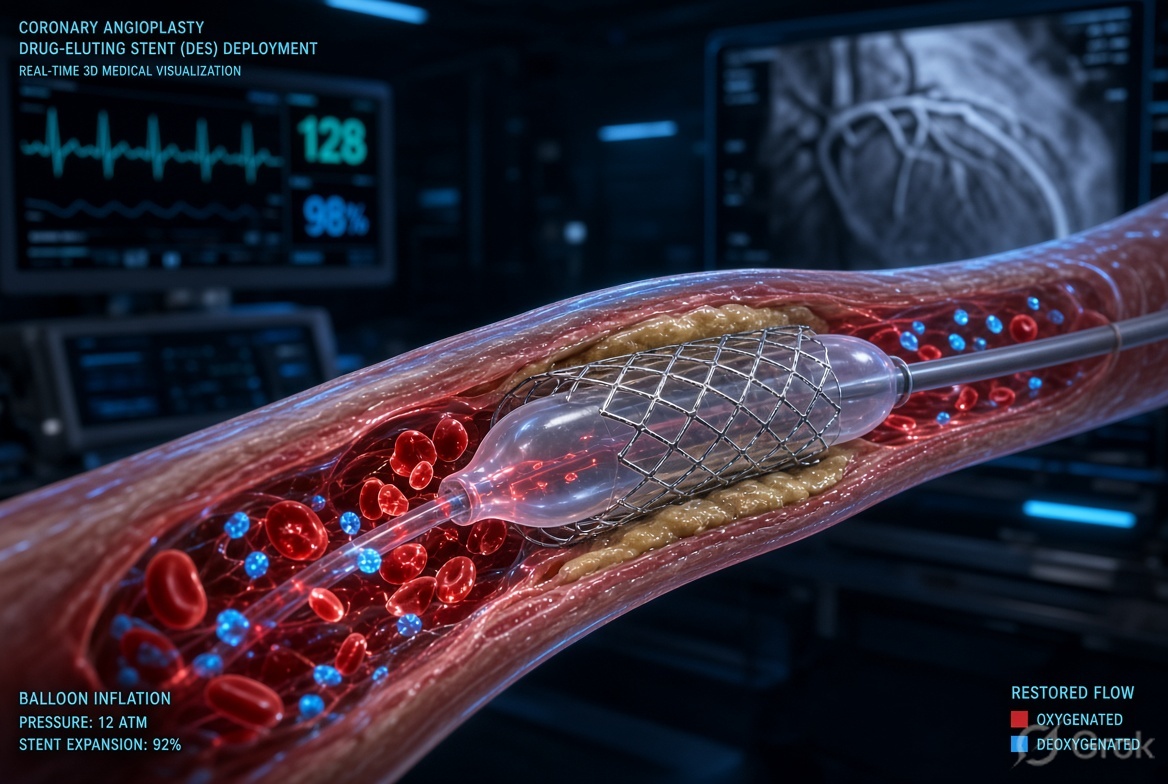
Coronary Angioplasty, medically referred to as Percutaneous Transluminal Coronary Angioplasty (PTCA) or Percutaneous Coronary Intervention (PCI), is a advanced cardiac catheter intervention designed to restore arterial blood flow to the heart muscle.
Over time, fatty deposits, cholesterol, and calcium form hardened plaques inside the coronary arteries (a condition called Atherosclerosis). As plaque accumulates, it restricts blood flow, causing symptoms like angina (chest pain), shortness of breath, or leading to an acute heart attack if the artery becomes completely obstructed by a clot.
2. Who Requires an Angioplasty Procedure?
An angioplasty is recommended by an interventional cardiologist in several key clinical scenarios:
- Acute Heart Attack (Primary PCI): Emergency angioplasty performed within the critical "Golden Hour" of a heart attack to unblock the artery and save heart muscle.
- Unstable Angina: Sudden, severe chest discomfort at rest or minimal exertion that does not respond to standard medications.
- Stable Angina: Ongoing exertional chest tightness or fatigue where diagnostic tests (TMT, Echo, or Coronary Angiogram) reveal severe arterial blockages.
- High-Risk Diagnostic Findings: Significant left main or multi-vessel disease confirmed during a catheter coronary angiography.
3. How the Procedure is Performed (Radial vs. Femoral Access)
Angioplasty is performed in a specialized cardiac catheterization laboratory (Cath Lab) equipped with high-resolution digital X-ray fluoroscopy.
The Transradial Advantage (Wrist Approach)
Dr. Bimal Kahar specializes in Transradial Angioplasty, where access is gained via the small radial artery in the wrist rather than the groin (femoral artery).
- Patient Comfort: Patients can sit up and walk almost immediately after the procedure.
- Reduced Bleeding Risk: Significantly lower risk of puncture site bleeding or hematomas.
- Shorter Hospitalization: Most elective radial angioplasty patients are discharged safely within 24 hours.
Step-by-Step Procedure Workflow:
- Local Anesthesia: Local anesthetic is injected into the wrist skin. The patient remains awake, relaxed, and fully comfortable throughout.
- Catheter Insertion: A thin, flexible hollow tube (sheath and catheter) is navigated under fluoroscopic guidance to the origin of the coronary arteries.
- Angiography: Contrast dye is injected to capture real-time motion images of arterial blockages.
- Balloon Inflation & Stent Delivery: A micro-wire is guided across the blockage. A miniature balloon is inflated to push plaque against the artery wall, followed by expanding a metallic mesh frame—a Stent.
4. Types of Cardiac Stents: Drug-Eluting Stents (DES)
Stents act as permanent scaffold towers inside the artery wall to ensure long-term vessel open-ness (patency).
Drug-Eluting Stents (DES): Modern practice utilizes 2nd and 3rd generation Drug-Eluting Stents coated with antiproliferative medication. This medication slowly releases over several weeks, preventing excessive scar tissue formation (restenosis) within the stent. DES has reduced long-term re-blockage rates to under 3-5%.
5. Post-Angioplasty Recovery & Lifestyle Guidelines
A successful angioplasty opens the blocked highway, but long-term heart protection requires active partnership between patient and physician:
- Antiplatelet Medication Adherence: Take dual antiplatelet therapy (DAPT) strictly as prescribed (e.g., Aspirin + Ticagrelor/Clopidogrel) without skipping doses to prevent blood clots on the stent.
- Hydration: Drink plenty of fluids for 24-48 hours post-procedure to flush out contrast dye through the kidneys.
- Gradual Activity: Avoid heavy lifting (over 5 kg) for 5-7 days if wrist access was used. Resume light walking immediately.
- Risk Factor Control: Maintain tight control over blood pressure, blood glucose (HbA1c < 6.5%), and cholesterol levels (LDL-C < 55 mg/dL).
Frequently Asked Questions (FAQs)
No. Coronary angioplasty is a minimally invasive catheter intervention, not open-heart surgery. It is performed through a tiny skin puncture under local anesthesia, requiring no chest incisions.
Modern Drug-Eluting Stents stay in the artery permanently. Over a few months, your natural arterial lining (endothelium) grows over the stent struts, making it an integral part of the vessel wall.
Most patients who undergo an elective transradial angioplasty can resume desk work and light activities within 3 to 7 days, under doctor clearance.
With modern Drug-Eluting Stents, re-blockage (restenosis) occurs in fewer than 5% of cases. Taking prescribed anti-platelet and cholesterol-lowering medications faithfully dramatically prevents future blockages.